
Astral Corp has been Earth’s foremost weapons and armor developer for over 100 years. During this time, the Earthen Council, made Astral Corp the official Research and Development department of the Cosmic Army.
Astral Corp began with designing armor for the soldiers of the Cosmic Army. They needed a material that was light enough not to burden space craft during launch. But, the material also need to offer protection for the environment and would be attackers. The material they developed was called Zyrlokan. Zyrlokan as light as Microlattice but harder to puncture than Kevlar. When woven into fabric, Zyrlokan, is flexible and breathable like cotton. The downsides to Zyrlokan are its low fire resistance and its relatively high conductivity. To combat those issues, Astral Corp developed a ceramic coating. The ceramic coating was then applied around several layers of fabric and imbedded with several microchip monitors. When tested again, the microchips provided real-time feedback. Electrical and flammability tests were better than expected and the puncture rating was top-notch.
The microchips were adapted for medical use. Once imbedded within the armor and synced with a soldier’s “skull chip”, real-time vital stats and injury reports could be gathered, and displayed.
After all of these had been accomplished, Astral Corp was able to form the armor to individual soldiers. Upon joining the Cosmic Army, each soldier is fitted for their specific set of armor.
A chest plate is formed from the soldier’s navel to their shoulders. A backplate covers roughly the same area. These two plates are held together by two latches on each shoulder and three latches on each flank. An emergency latch is set between the two regular latches on each shoulder. When pulled, the emergency latch disconnects all other latches from inside the backplate. This allows the armor to be stripped off quickly if needed.
Armor is formed for the soldiers shins, knees, thighs, and upper arms. All of these areas are secured to the soldier with straps and buckles. The forearm armor has a built-in touchscreen with several controls and displays. This touchscreen can be used to switch radio frequencies, turn on external speakers, check a holstered weapon’s status, or show area maps and battle plans.
The head armor has a faceplate and helmet. The faceplate is made of a glass like material that is extremely resistant to scratches, chips, or breaking. The outside of the faceplate is coated with a translucent material, making it more difficult for an enemy to see the soldier’s face. On the inside of the faceplate, a heads-up-display (HUD) displays information for the soldier. Some of the information includes; radio transmissions, vital signs, compass/ GPS, and a power pack heat indicator. The helmet forms around the top, back, and sides of the soldier’s head. It forms over the soldier’s ears and jaw, almost matching the shape of a skull perfectly. Jutting from each side is a small light, a small speaker, and a small camera. The light’s can be turned on and off, as well as, changed to white, red, or green hues. The speakers are used to communicate with soldiers or individuals who did not have radio. The camera could be turned on to display along the inside of the faceplate. The camera can display night vision, thermal view, or regular view. All three of these settings can be zoomed in and out. On the rear right of the helmet a dime sized port allows soldiers to link their views and vital signs. This port is primarily used by medics and squad leaders.
Armor development occurred over the span of two years. Weapon development began six months into the armor development.
The most difficult part of weapon development was the power source. A suitable power source took one year to develop. The power source was a compact form of nuclear fusion. The power packs range in size from that of a small backpack to smaller than a deck of cards. Power packs never ran out of energy. The limiting factor on these power packs is overheating. If a power pack is used too frequently, it will explode. The explosion of a small pack will vaporize anyone and anything within two meters and be deadly for ten meters beyond that. When a power pack begins to heat up, it can be changed. Changing the pack allows the heated pack to cool and be useable once more.
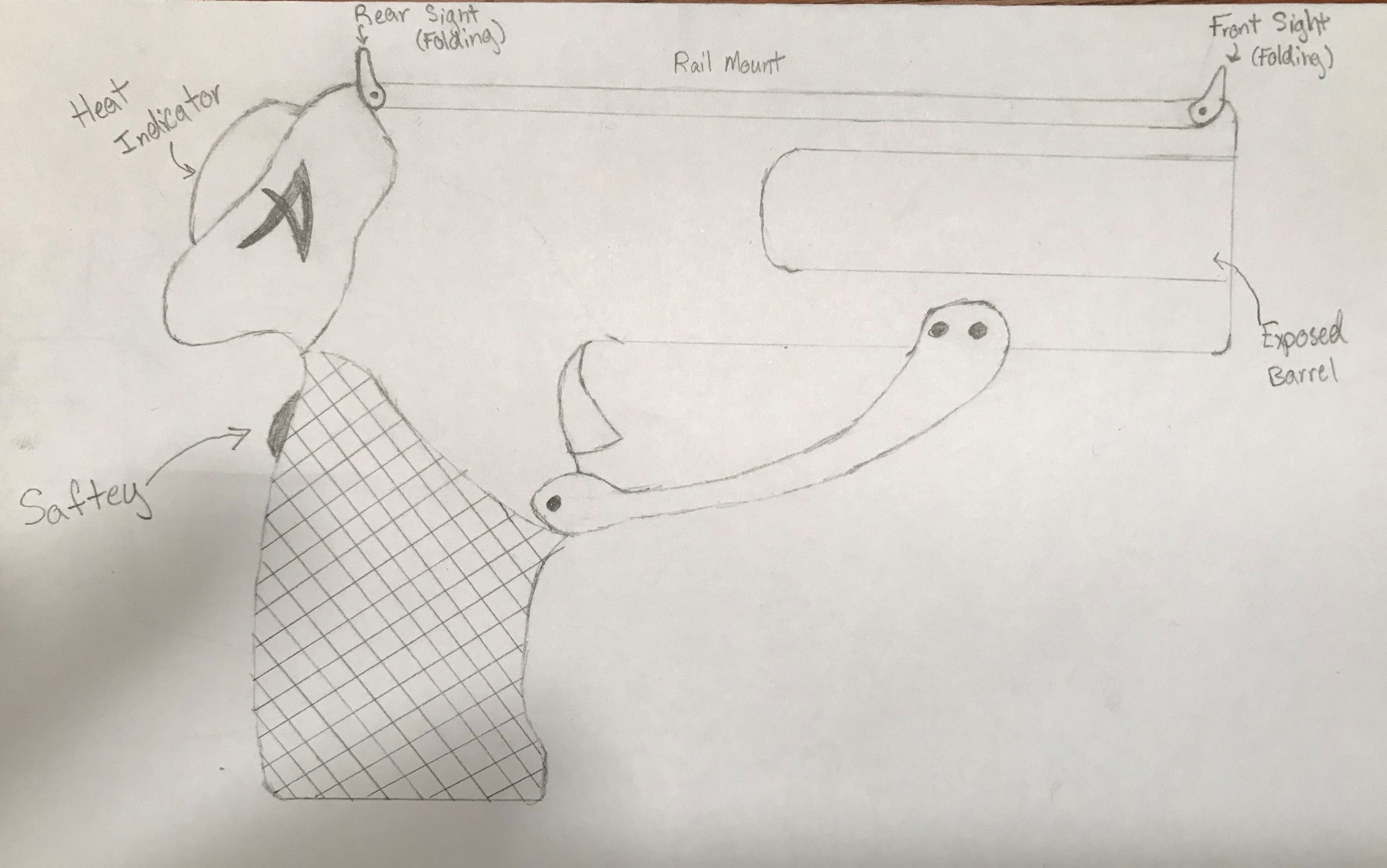
Weapons were then developed to harness this nuclear power and transform it into a destructive projectile. Each weapon is designed to release a different amount of the energy. A pistol releases the least amount of energy, making it more deadly at shorter distances. A sniper rifle unleashes a high amount of focused energy, allowing the wielder to be deadly from a great distance. Rifles and machine guns release a moderate amount of energy at a rapid pace. Machine guns are equipped with a special cooling system that allowed the weapon to discharge for several minutes at a time.
Every weapon is equipped with a heat indicator. The indicator displays how hot the power pack is, allowing the soldier to monitor the pack’s status. As a redundancy, a heat reading is also displayed in the upper right portion of the soldier’s faceplate HUD.
Astral Corp., Number 1 in protection and destruction!
 Cranial Notations